


Updated and expanded content to serve as a reference guide.
Index
Recommended reading
If you want to delve deeper, you might be interested in:
Definition and meaning
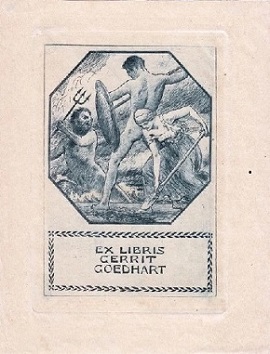
An exlibris (from Latin ex libris, "from the books of...") is an ownership mark that is placed, usually, on the endpaper or first page of a book to identify its owner or the library to which it belongs. It can take the form of a printed label, a print or a small engraving.
The key is that an exlibris is not just "a stuck-on name": over time it became a miniature work of art. In a few square centimeters it can condense an entire world: symbols, mottos, professions, hobbies, heraldry, literature, totemic animals or intimate references. That's why the exlibris is spoken of as an "indirect portrait" of its owner.
Why do exlibris exist?
For centuries, books were expensive, hard-to-come-by and highly prized items. Marking ownership was a practical way to prevent losses, identify loans and organize libraries. In monastic and university settings, the circulation of books made any clear sign of belonging useful.
Something more was added to this utility: the idea that a library has an identity. Thus, the exlibris went from being a simple "this book is mine" to being an aesthetic and cultural statement: a small emblem that accompanies the reader and the book through time.
- Identity: your library is recognized as a set with personality.
- Bibliophile tradition: connects with a European practice with centuries of history.
- Art: allows you to enjoy engraving and design on an intimate scale.
- Collecting: they are exchanged and collected for their artistic and historical value.
Origin and history of the exlibris (by period)
15th Century: the birth of the printed exlibris
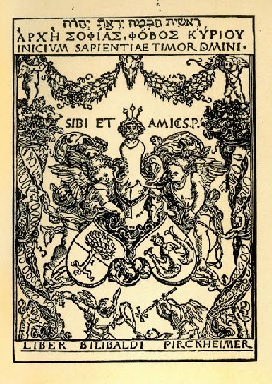
Exlibris as we understand them today appear in Europe shortly after the printing press. The first known examples are associated with Germanic territories, where woodcut allowed for the reproduction of images in series. It was the perfect context: printing + circulation of books + need for ownership.
Renaissance: heraldry, lineages and libraries
With the Renaissance, heraldic exlibris became widespread, featuring coats of arms, helmets, ornaments and mottos. In many cases, the mark spoke not only of the individual, but of the lineage, status and family tradition.
17th–18th Centuries: refinement and taste for engraving
As the book became more accessible, the exlibris diversified. Intaglio printing (on metal) gained prominence and more elaborate compositions appeared, with Baroque ornaments, depicted libraries and intellectual symbols.
19th Century: rise of collecting
In the 19th century, with the growth of private libraries and collector culture, the exlibris also became an object of exchange. More "personal" designs emerged (not just shields) and styles associated with artistic movements, especially at the turn of the century.
20th–21st Centuries: from artistic exlibris to contemporary design
In the 20th century, the exlibris opened up to modern languages: simplification, abstraction, humor, literary references and conceptual designs. Nowadays, traditional engraving coexists with digital design and high-quality printing. The spirit remains the same: to mark a library and express identity.
If you want to go into more detail with examples, visit: History of the Exlibris.
Production techniques
An exlibris can be made using multiple techniques. Some belong to the world of classical engraving; others rely on modern tools. Choosing a technique influences the result (texture, line, tone) and also the "character" of the piece.
Woodcut
A wood block is carved: the raised areas are inked and printed. The result often has a powerful graphic character and expressive lines.
Etching and drypoint
In etching, a design is drawn on a metal plate coated with ground and "bitten" with acid; in drypoint, it is scratched directly. Ideal for fine lines and great detail.
Lithography
Based on the repulsion between grease and water on a stone or plate. Allows for very free strokes, close to drawing.
Screen printing
Ink is pushed through a mesh with a stencil. Widely used in contemporary designs and works with flat color.
Digital design and printing
A modern option: vector design or digital illustration + quality printing. It's practical and accessible, although it doesn't reproduce the texture of traditional engraving.
Types of exlibris (with examples and features)
The types are not watertight compartments: an exlibris can be heraldic and, at the same time, artistic; typographic and modern. Still, these categories help to understand styles and traditions.
1) Heraldic exlibris
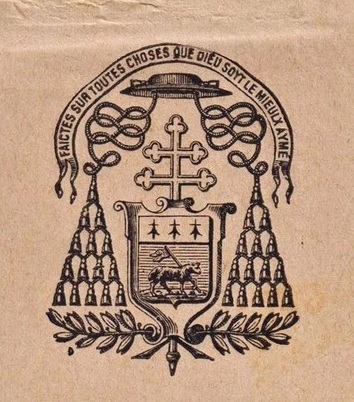
It displays the owner's coat of arms or blazon. It was very common in noble libraries and old collections. They often include crowns, helmets, mantling and family mottos.
2) Artistic exlibris
Designed by an artist with compositional freedom. It can include symbolic portraits, scenes, allegories, architecture, mythology or literary references. It is the most varied type and the favorite of many collectors.
3) Typographic exlibris
Based mainly on letters: careful typography, monograms, initials and editorial composition. It is often minimalist and works very well in modern libraries.
4) Modern or contemporary exlibris
It encompasses current styles: digital design, abstraction, humor, cultural icons, geometry or modern illustration. It may maintain the formula "Ex Libris + name" or reinterpret it.
Practical idea: if your library is very visual (art, comics, photography), an artistic exlibris fits; if you seek discretion, the typographic one is usually ideal.
Symbolism and common elements
A good exlibris "speaks" without needing to explain anything. To do this, it uses classic or personal symbols. These are some of the most frequent elements and what they usually convey:
Animals
The owl suggests wisdom; the lion, strength; the cat, independence; the hedgehog can allude to protection and character.
Books, lamps and libraries
Classic intellectual motifs: stacked books, bookshelves, globes or lamps. They work very well in bibliophiles' exlibris.
Monograms and initials
Intertwined letters or typographic compositions. They are an elegant and timeless signature if you don't want a figurative scene.
Heraldry and mottos
Shields, crowns and crests. Mottos are often in Latin or the owner's language and add tradition.
Profession and hobbies
Musical instruments, tools, brushes, maps or scientific elements turn the exlibris into a personal portrait.
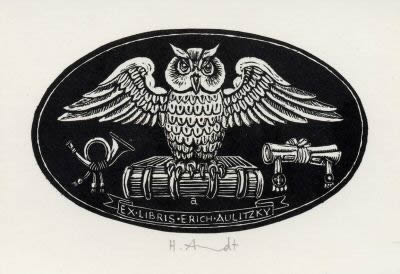
Tip: choose 1 main idea (for example, "my library is a refuge") and translate it into a strong symbol (a key, a door, a lighthouse). Fewer elements usually result in a more memorable design.
How to commission or create your exlibris
There are two paths: commission it from an artist (ideal if you want an authentic engraving) or design it yourself (perfect if you're looking for something quick and inexpensive). In either case, these steps help you get it right:
- Define the text: "Ex Libris" + your name. Optional: "Ex Bibliotheca" if you want a more "library" tone.
- Choose a style: heraldic, artistic, typographic or modern (or a mix).
- Select symbols: 1–3 elements that represent you (animal, motto, profession, city, favorite author…).
- Decide on a technique: traditional engraving (texture and "soul") vs. digital (practicality and speed).
- Define the size: the usual range is between 6 and 10 cm wide, thinking about endpapers and first pages.
- Paper and adhesive: use good quality paper and neutral adhesive (better for conservation).
If you want a step-by-step guide with design ideas, go here: Create your exlibris.
Collecting and conservation
The exlibris is also collected as a graphic piece. Many people exchange prints, follow authors and gather series by styles (Art Nouveau, heraldic, contemporary, typographic, etc.). To preserve them well:
- Avoid humidity and direct sunlight (they can yellow paper and inks).
- Use acid-free sleeves or folders if you collect loose prints.
- Document your pieces: author, technique, year, provenance and condition.
- If you paste exlibris into valuable books, use reversible adhesives and stable paper.
Looking for inspiration? Explore the Authors Gallery to see different styles.
Frequently asked questions
Is an exlibris the same as a stamp?
Not exactly. A stamp is a tool for stamping ink directly (and it's usually repeated without variation). An exlibris is usually a print/label that is pasted, although "stamp exlibris" can also exist. The main difference is cultural: the exlibris is usually cared for as an artistic piece.
Must it always include "Ex Libris"?
It's traditional, but not mandatory. Many collectors prefer it because it clearly identifies it as an exlibris. "Ex Bibliotheca" or equivalent formulas are also used.
Where is it placed inside the book?
The most common is on the endpaper (the inner page of the cover) or on the first blank page. Avoid placing it over printed text.
What size is recommended?
Between 6 and 10 cm wide is usually a comfortable range. The important thing is that the name is readable and the design doesn't "invade" too much.
What is the oldest exlibris?
Very early examples from the 15th century are cited, associated with the spread of the printing press in Germanic territories. Beyond specific names, what matters is the context: engraving and multiple reproduction in the service of private libraries.
Next step
If you're just starting out, I recommend this path: What is it → History → Techniques → Create your exlibris.