



Exlibris in Spain: history and evolution
Exlibris in Spain are part of a long tradition of bibliographic ownership marks that combines book history, heraldry, engraving and collecting. Although there were precedents in medieval codices and manuscripts, the first preserved and generally recognized Spanish exlibris is the one used by Francisco Tarafa, a Catalan historian and archivist of Barcelona Cathedral.
This first known Spanish exlibris consists of an oval woodcut, with a coat of arms and the date 1553, bearing the inscription “Bibliotheca Francisci Tarapha, Canonici Barchi”. Its importance is not only national: it is also considered one of the most significant early examples of European exlibris culture.
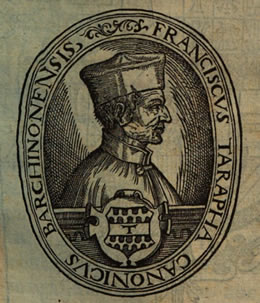
Francisco Tarafa’s exlibris (1553), considered the first known in Spain
The 17th and 18th centuries: exlibris for the nobility and clergy
During the 17th and 18th centuries, Spanish exlibris were mainly linked to aristocratic, ecclesiastical and court libraries. The most highly regarded engravers produced works for members of the Royal Household, the nobility and the high clergy, using a visual language dominated by heraldry, family coats of arms and institutional solemnity.
Among the most notable examples are those made by the Flemish engraver Juan Schoerquens for Don Juan of Austria, as well as those engraved by Antonio Salvador Carmona for Pedro Álvarez de Toledo, Duke of Alba, and for the Infante Luis Antonio de Borbón, following designs drawn by artists such as Carnicero and Maella.
Goya and Jovellanos: a jewel of Spanish exlibris art
At the end of the 18th century, one of the most admired pieces in Spanish exlibris history appears: the heraldic exlibris that Francisco de Goya engraved for his friend Melchor Gaspar de Jovellanos. It is an etching of which only two proofs are known.
One of them is preserved in the National Library of Spain and bears the inscription “Del Sº Jovellanos”, as well as Goya’s signature. This engraving was probably executed between 1780 and 1798, and it is an extraordinary rarity within the graphic production of the Aragonese painter and within the history of exlibris in Spain.
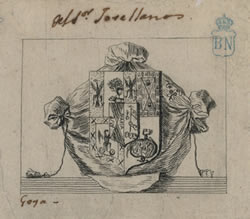
Rare exlibris engraved by Francisco de Goya for Jovellanos
Modern exlibris culture in Spain
Modern exlibris culture in Spain began in the 19th century with Mariano Pardo de Figueroa, known as Dr. Thebussen, who published in 1875 in Ilustración Española e Iberoamericana one of the first Spanish studies devoted to the subject.
Soon after, the bibliophile Pablo Font de Rubinat encouraged interest in exlibris after his visit to the Paris Universal Exposition of 1898, where he was able to see collections from the National Library of Paris. That contact with the international milieu helped spread exlibris collecting in Spain.
The 1901 National Exhibition of Fine Arts, which included works by José Triadó, gave the movement new momentum. In 1902 the Association of Iberian Exlibrists was founded, and in 1903 the Revista Ibérica de Ex Libris began publication, a key journal for the dissemination, study, exchange and artistic appreciation of these works.
Milestones of Spanish exlibris culture
- 1553: Francisco Tarafa’s exlibris, first known Spanish example
- 17th–18th centuries: Development of heraldic exlibris for the nobility and clergy
- Late 18th century: Goya engraves Jovellanos’s exlibris
- 1875: Dr. Thebussen publishes one of the first Spanish studies on exlibris
- 1898: Influence of the Paris Universal Exposition
- 1901: Exlibris featured in the National Exhibition of Fine Arts
- 1902: Foundation of the Association of Iberian Exlibrists
- 1903: Launch of the Revista Ibérica de Ex Libris
The cultural value of Spanish exlibris
Exlibris in Spain do not only serve to indicate the ownership of a book. They are also historical documents that make it possible to study old libraries, private collections, patronage networks, artistic tastes and the evolution of engraving techniques.
For this reason, exlibris interest bibliophiles, art historians, collectors and specialists in bibliographic heritage. For more context, you can also visit our pages about what an exlibris is, the general history of exlibris and the authors gallery.
Frequently asked questions about exlibris in Spain
What is the first known exlibris in Spain?
The first preserved Spanish exlibris is generally considered to be Francisco Tarafa’s, dated 1553.
Did Goya design exlibris?
Yes. One of the best-known and rarest examples is the exlibris engraved for Jovellanos, of which very few proofs survive.
Why is Tarafa’s exlibris important?
Besides being the first known Spanish exlibris, it is also considered a very early piece within the history of European exlibris culture.
When did modern exlibris culture emerge in Spain?
It is usually placed in the late 19th and early 20th centuries, with figures such as Mariano Pardo de Figueroa, Pablo Font de Rubinat and the Revista Ibérica de Ex Libris.
Where can collections of Spanish exlibris be seen?
The National Library of Spain, the Library of Catalonia and other institutions preserve important collections related to Spanish exlibris culture.
Sources and historical context
This page summarizes milestones in the history of exlibris in Spain based on specialized bibliography, library catalogues, studies on engraving, collecting and historical publications devoted to Spanish exlibris culture.
The aim of Exlibrismo.com is to offer clear and useful introductory content for readers interested in the history of the book, bibliographic ownership marks and the artistic evolution of exlibris.