



Linocut printmaking
Introduction
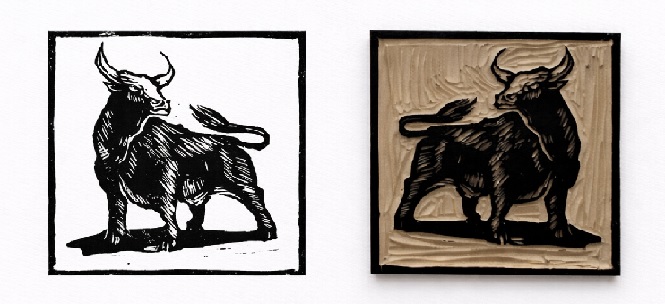
Linocut, also called linocut printmaking, is a relief printing technique that consists of carving an image into a sheet of linoleum, inking the raised surface, and transferring it onto paper by applying pressure.
It is a relatively modern technique within the history of printmaking, but it is highly valued by artists and print workshops because of its technical simplicity, strong expressive potential, and bold visual contrast.
Origin and history
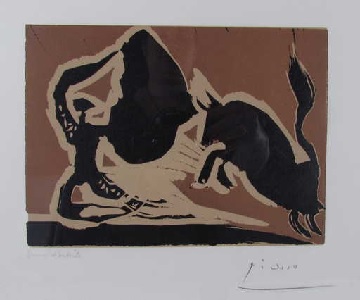
Linoleum was invented in 1860 by Frederick Walton as a flooring material. Soon afterwards, artists and printmakers began using it as a support for printmaking after discovering that it was easier to carve than wood.
Linocut became popular in the 20th century, especially among artists linked to modern movements such as Expressionism and experimental graphic art.
One of the artists who explored this technique extensively was Pablo Picasso, who produced important series of linocuts in the 1950s.
Materials and tools
Linocut printmaking requires only a few materials, which has contributed to its popularity in art and educational workshops.
The main elements are:
- Linoleum block (the support on which the image is carved)
- Gouges and knives for carving
- Roller (brayer) for applying the ink
- Printing ink
- Printmaking paper
- Printing press or hand pressure
Linoleum is often mounted on a rigid board or backing to make it easier to work with.
How it is made
- Designing the image: the artist draws the design on the linoleum sheet. They must keep in mind that the final image will appear reversed when printed.
- Carving: gouges are used to remove the areas that should not receive ink. The raised areas are the ones that will print.
- Inking: ink is rolled onto the surface of the block.
- Printing: the paper is placed over the inked block and pressure is applied either with a press or by hand.
- Editioning the print: the same block can be used to produce multiple impressions of the image.
Characteristics of linocut
Linocut has several very distinctive visual features:
- Soft, flowing lines, due to the ease with which the material can be carved.
- Uniform surface, without wood grain.
- Strong black-and-white contrasts.
- Direct, graphic, and simplified style, very suitable for expressive compositions.
These qualities make linocut especially effective for decorative, symbolic, or visually striking images.
Differences between linocut and woodcut
| Linocut | Woodcut |
|---|---|
| Carved on linoleum | Carved on wood |
| Soft, homogeneous material | Hard material with grain |
| Softer, more curved lines | Lines more influenced by the grain |
| Smooth surface | May show wood texture |
For this reason, many artists consider linoleum a more flexible and accessible technique, while woodcut has an aesthetic more closely tied to the texture of the support.
Artistic uses of linocut
Linocut is used in many areas of graphic art:
- Fine art prints
- Illustration
- Posters
- Bookplates / exlibris
- Book editions
- Educational printmaking workshops
Its ability to create clear and powerful images has made it a highly valued technique in both contemporary art and printmaking education.
Conclusion
Linocut is an accessible and expressive technique that combines technical simplicity with strong visual impact. Thanks to its ease of carving and the clarity of its results, it has become one of the most widely used printmaking methods in graphic art workshops.
Although it is a relatively recent technique in the history of printmaking, linocut has shown a remarkable ability to adapt to different artistic styles and remain relevant in contemporary artistic practice.
Bibliography
- Ross, John; Romano, Clare; Ross, Tim. The Complete Printmaker. Free Press, 1990.
- Griffiths, Antony. Prints and Printmaking: An Introduction to the History and Techniques. University of California Press, 1996.
- Gascoigne, Bamber. How to Identify Prints. Thames & Hudson, 2004.
- Ivins, William M. Prints and Visual Communication. MIT Press, 1969.
- Hayter, Stanley William. New Ways of Gravure. Oxford University Press, 1966.