



History of the Exlibris (Bookplate)
In English, exlibris are often called bookplates—small labels or prints placed inside a book to mark ownership. They combine book history, printmaking, and personal symbolism.
Origins in Ancient Egypt
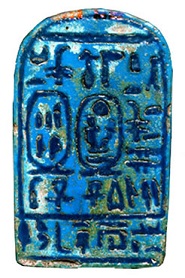
Replica of the clay tablet of Amenhotep III (Amenophis III), often cited as the earliest known exlibris / book ownership mark
The oldest known precedent of an exlibris is an Egyptian fired-clay tablet kept in the British Museum. It bears a hieroglyphic inscription indicating that it belonged to the library of Pharaoh Amenhotep III (Amenophis III), who ruled Egypt approximately between 1391 and 1353 BCE.
The Middle Ages and the birth of the modern exlibris
In the Middle Ages we find early handwritten ownership notes in manuscripts and codices. However, the exlibris as we understand it today emerged alongside the printing press, and its evolution is closely linked to the history of printing and engraving.
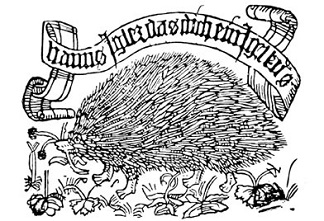
Hans Igler (c. 1450)
Germany is often considered the birthplace of the printed exlibris. One of the first documented examples is attributed to the cleric Knabensberg, known as Hans Igler (“John Hedgehog”). The design shows a porcupine/hedgehog eating wild flowers, playing on the owner’s name.
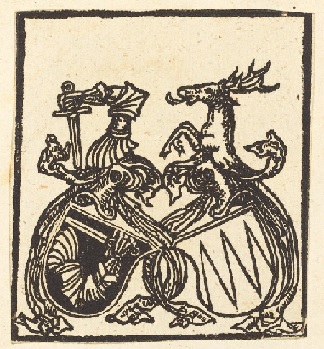
Wilhem von Zell (c. 1470)
Another early dated exlibris is that of Wilhem von Zell, from a Bavarian family with a notable library later linked to the Charterhouse of Buxheim. The coats of arms symbolize the owner and his wife.
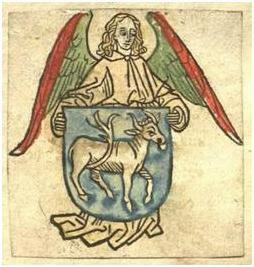
Hildebrando Brandenburg (c. 1470)
A third very early example is associated with Hildebrando Brandenburg of Biberach, a monk of the Buxheim Charterhouse. His colored exlibris shows an angel holding the family coat of arms.
The Renaissance and the spread of the exlibris
During the Renaissance, exlibris spread across Europe along with printing. Artists such as Albrecht Dürer in Germany and Lucas Cranach the Elder designed bookplates for nobles and clergy, reinforcing the link between exlibris, heraldry, and cultural prestige.
Timeline: key moments in exlibris history
- 1391–1353 BCE: Amenhotep III ownership tablet (Egypt)
- c. 1450: Early printed exlibris (Hans Igler, Germany)
- c. 1470: Exlibris of Wilhem von Zell and Hildebrando Brandenburg
- 1503: Albrecht Dürer creates exlibris for Willibald Pirckheimer
- 16th century: Expansion across Europe
Art Nouveau / Modernism: the golden age of the exlibris
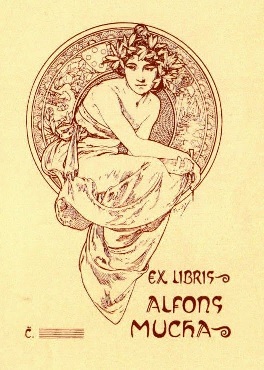
Art Nouveau / Modernist exlibris from the early 20th century
With Art Nouveau (Modernism), exlibris flourished and became a vehicle for artistic trends. From this period onward, monographic studies appeared, early bookplate collectors organized exchanges, and exhibitions were dedicated specifically to exlibris and bookplate design.
In this way, exlibris became an instrument that—besides marking a book’s ownership—also showcased an artist’s work and satisfied the passion of collectors and bibliophiles.
Artistic bookplates
During the Art Nouveau era, artists such as Aubrey Beardsley, Alphonse Mucha, and others created highly collectible, visually striking exlibris.
Collecting and exchange
Systematic collecting grew, along with bookplate swapping and correspondence between enthusiasts—an early global community of exlibris collectors.
Exhibitions
The first exhibitions dedicated exclusively to the art of the exlibris helped establish bookplates as a recognized graphic art form.
Related reading: What is an Exlibris? · Woodcut (Xilography) · Create your Exlibris