



Ottohans Beier
Biografía
Ottohans Beier nació en Karlsruhe el 9 de octubre de 1892 y murió en Múnich el 2 de febrero de 1979. Fue pintor, dibujante, grabador y artista de exlibris alemán, reconocido especialmente por su dominio de la litografía, el aguafuerte y el grabado al buril.
Estudió en la Escuela de Artes Aplicadas de Karlsruhe durante el curso 1913-1914. La Primera Guerra Mundial interrumpió su formación y, durante su cautiverio en Inglaterra, editó el periódico del campo de prisioneros Piepmatz.
En 1919 se estableció en Múnich. Entre 1933 y 1958 fue profesor de artes gráficas en la Bayerische Staatslehranstalt für Lichtbildwesen, actividad que compaginó con la pintura, el dibujo y el grabado.
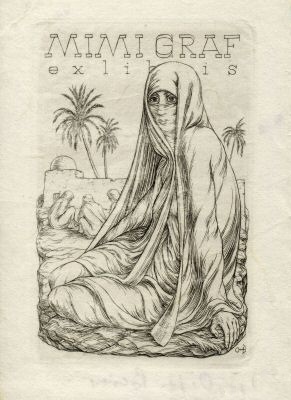
Su producción evolucionó desde la litografía hacia el aguafuerte y, posteriormente, hacia el buril. Realizó aproximadamente 272 exlibris, caracterizados por el dibujo preciso, el cuidado del claroscuro y la presencia de motivos históricos, arquitectónicos y alegóricos. Entre sus obras destaca la serie Ein Totentanz, formada por ocho grabados inspirados en la danza de la muerte.
En 1937 su pintura Las dos hermanas fue confiscada y destruida durante la campaña contra el llamado arte degenerado. Sin embargo, otras obras suyas fueron exhibidas en exposiciones oficiales alemanas. Beier no perteneció al Partido Nacionalsocialista.
En 1946 fue uno de los miembros fundadores del Verein für Original-Radierung. Recibió el Premio Durero en 1930 y una Medalla de Oro en la Exposición Universal de París de 1937.
Sus obras se conservan en importantes colecciones alemanas. La calidad técnica y la amplitud de su producción lo convierten en una figura destacada del grabado y del exlibrismo europeo del siglo XX.
Biography
Ottohans Beier was born in Karlsruhe on 9 October 1892 and died in Munich on 2 February 1979. He was a German painter, draughtsman, printmaker and bookplate artist, particularly known for his mastery of lithography, etching and copper engraving.
He studied at the Karlsruhe School of Applied Arts during 1913-1914. His training was interrupted by the First World War. While held as a prisoner of war in England, he edited the camp newspaper Piepmatz.
Beier settled in Munich in 1919. From 1933 to 1958 he taught graphic arts at the Bayerische Staatslehranstalt für Lichtbildwesen, while continuing his work as a painter, draughtsman and printmaker.
His graphic work developed from lithography to etching and later to copper engraving. He created approximately 272 bookplates, distinguished by precise drawing, carefully controlled light and shade, and frequent historical, architectural and allegorical subjects. Among his best-known works is Ein Totentanz, a series of eight engravings based on the Dance of Death.
In 1937 his painting The Two Sisters was confiscated and destroyed during the campaign against so-called degenerate art. Other works, however, were included in official German exhibitions. Beier was not a member of the Nazi Party.
In 1946 he became one of the founding members of the Verein für Original-Radierung. He received the Dürer Prize in 1930 and a Gold Medal at the Paris International Exposition of 1937.
His works are held in major German collections. His technical skill and extensive production established him as an important figure in twentieth-century European printmaking and bookplate art.
Biographie
Ottohans Beier est né à Karlsruhe le 9 octobre 1892 et mort à Munich le 2 février 1979. Il fut peintre, dessinateur, graveur et artiste d’ex-libris allemand, particulièrement reconnu pour sa maîtrise de la lithographie, de l’eau-forte et de la gravure au burin.
Il étudia à l’École des arts appliqués de Karlsruhe en 1913-1914. Sa formation fut interrompue par la Première Guerre mondiale. Pendant sa captivité en Angleterre, il dirigea le journal du camp de prisonniers Piepmatz.
Beier s’installa à Munich en 1919. De 1933 à 1958, il enseigna les arts graphiques à la Bayerische Staatslehranstalt für Lichtbildwesen, tout en poursuivant son activité de peintre, dessinateur et graveur.
Son œuvre graphique évolua de la lithographie vers l’eau-forte, puis vers la gravure au burin. Il réalisa environ 272 ex-libris, caractérisés par un dessin précis, un clair-obscur soigneusement maîtrisé et la présence de thèmes historiques, architecturaux et allégoriques. Parmi ses œuvres les plus connues figure Ein Totentanz, une série de huit gravures inspirées de la danse macabre.
En 1937, sa peinture Les deux sœurs fut confisquée et détruite pendant la campagne contre l’art dit dégénéré. D’autres œuvres furent cependant présentées dans des expositions officielles allemandes. Beier ne fut pas membre du Parti national-socialiste.
En 1946, il fut l’un des membres fondateurs du Verein für Original-Radierung. Il reçut le Prix Dürer en 1930 et une médaille d’or à l’Exposition internationale de Paris de 1937.
Ses œuvres sont conservées dans d’importantes collections allemandes. Sa maîtrise technique et l’étendue de sa production en font une figure notable de la gravure et de l’exlibrisme européen du XXe siècle.