



Ladislav J. Kašpar
Biografía
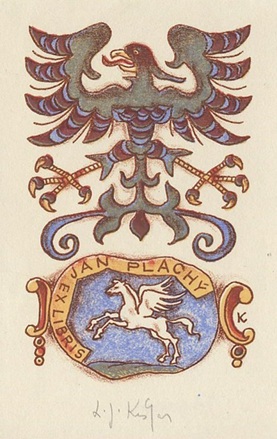
Ladislav Josef Kašpar (Travnik, Bosnia, 1915 – Praga, 1997) fue un pintor, grabador, ilustrador y pedagogo checo, considerado una de las figuras más destacadas del exlibris centroeuropeo del siglo XX.
Se trasladó con su familia a Praga en 1918 y desde muy joven mostró una marcada vocación artística. Estudió en la Escuela Estatal de Artes Gráficas de Praga con Josef Konůpek y posteriormente en la Escuela de Artes Aplicadas (UMPRUM) bajo la dirección de Jaroslav Benda. Tras la Segunda Guerra Mundial completó estudios de pintura figurativa en la Academia de Bellas Artes de Praga con Vladimír Nechleba.
Kašpar desarrolló una extensa actividad como ilustrador, grabador y profesor. Enseñó dibujo y litografía en diversas escuelas artísticas de Praga y colaboró con la asociación gráfica SČUG Hollar. También realizó ilustraciones para la editorial Orbis y numerosas publicaciones checas.
Su producción artística abarcó el dibujo, la pintura, la litografía y el grabado en madera y metal, aunque alcanzó especial reconocimiento por sus exlibris y pequeñas estampas gráficas. Desde la década de 1940 creó cientos de obras caracterizadas por la riqueza ornamental, el uso creativo de la tipografía y una marcada influencia de la Secesión vienesa y praguense.
Sus composiciones combinan elementos simbólicos, surrealistas y cubistas con una gran libertad imaginativa. Muchas de sus obras incorporan humor, detalles decorativos y una refinada sensibilidad gráfica. También destacó por sus litografías policromas y por sus delicadas felicitaciones de Año Nuevo.
Participó en numerosas exposiciones nacionales e internacionales y obtuvo diversos reconocimientos, entre ellos la medalla de plata en la Exposición Universal de París de 1937 por un cartel dedicado a Praga. Sus exlibris son hoy especialmente apreciados por coleccionistas y estudiosos del arte gráfico europeo.
Biography
Ladislav Josef Kašpar (Travnik, Bosnia, 1915 – Prague, 1997) was a Czech painter, engraver, illustrator and teacher, regarded as one of the most remarkable Central European ex libris artists of the 20th century.
He moved to Prague with his family in 1918 and showed artistic talent from an early age. He studied at the State Graphic School in Prague under Josef Konůpek and later at the Academy of Applied Arts (UMPRUM) with Jaroslav Benda. After World War II he continued his studies in figurative painting at the Academy of Fine Arts in Prague with Vladimír Nechleba.
Kašpar worked extensively as an illustrator, printmaker and educator. He taught drawing and lithography in Prague and collaborated with the prestigious SČUG Hollar association. He also produced illustrations for the Orbis publishing house and several Czech magazines.
His artistic work included drawing, painting, lithography, woodcut and metal engraving, although he became especially renowned for his ex libris and small graphic prints. From the 1940s onward he created hundreds of works distinguished by ornamental richness, experimental typography and the influence of Viennese and Prague Secession art.
His compositions combined symbolic, surrealist and cubist elements with a playful imagination and refined decorative style. Many of his works reveal subtle humor and strong graphic sensitivity. He was also highly regarded for his multicolored lithographs and New Year greeting prints.
Kašpar participated in numerous exhibitions in Czechoslovakia and abroad. Among his distinctions was the silver medal awarded at the 1937 Paris World Exhibition for a poster dedicated to Prague. Today his ex libris works are highly appreciated by collectors and scholars of European graphic art.
Biographie
Ladislav Josef Kašpar (Travnik, Bosnie, 1915 – Prague, 1997) fut un peintre, graveur, illustrateur et professeur tchèque, considéré comme l’un des grands créateurs d’ex-libris d’Europe centrale au XXe siècle.
Installé à Prague avec sa famille dès 1918, il manifesta très tôt des dispositions artistiques. Il étudia à l’École d’Arts Graphiques de Prague auprès de Josef Konůpek puis à l’École des Arts Appliqués (UMPRUM) dans l’atelier de Jaroslav Benda. Après la Seconde Guerre mondiale, il poursuivit des études de peinture figurative à l’Académie des Beaux-Arts de Prague avec Vladimír Nechleba.
Kašpar mena une importante activité comme illustrateur, graveur et enseignant. Il enseigna le dessin et la lithographie dans plusieurs écoles artistiques de Prague et collabora avec l’association graphique SČUG Hollar. Il réalisa également des illustrations pour la maison d’édition Orbis.
Son œuvre comprend dessins, peintures, lithographies, gravures sur bois et sur métal, mais il demeure surtout célèbre pour ses ex-libris et ses petites estampes graphiques. Dès les années 1940, il développa un style personnel marqué par l’ornementation, la richesse typographique et l’influence de la Sécession viennoise et pragoise.
Ses compositions associent éléments symboliques, cubistes et surréalistes avec une imagination décorative très libre. Beaucoup de ses œuvres révèlent un humour discret et une grande sensibilité graphique. Il fut également reconnu pour ses lithographies polychromes et ses cartes de vœux gravées.
Il participa à de nombreuses expositions en Tchécoslovaquie et à l’étranger. Parmi ses distinctions figure la médaille d’argent obtenue à l’Exposition universelle de Paris de 1937 pour une affiche consacrée à Prague. Ses ex-libris sont aujourd’hui très recherchés par les collectionneurs d’art graphique européen.