



Georg Jilovsky
Biografía
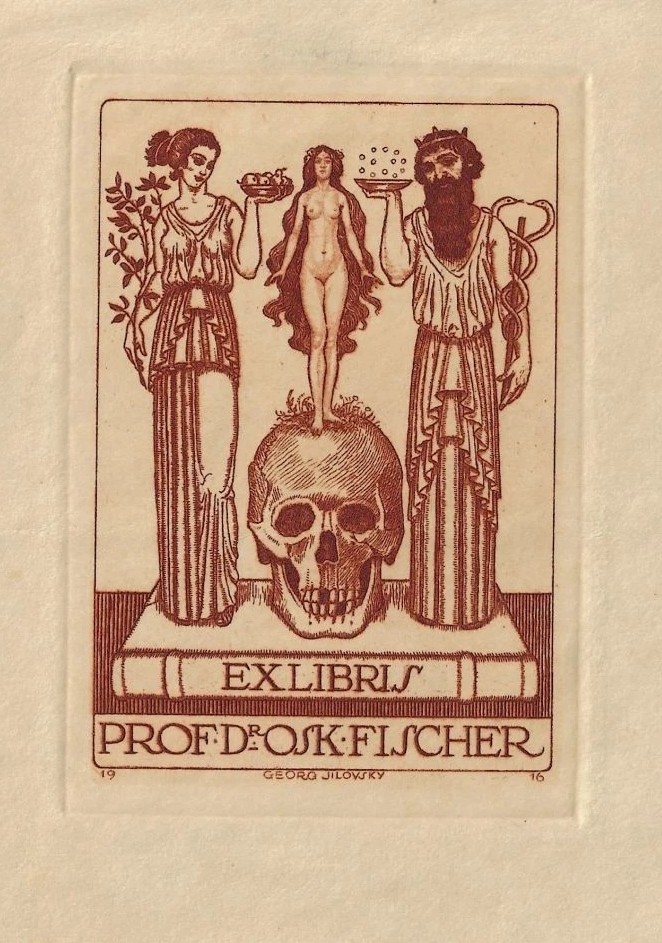
Georg Jilovsky, también conocido por la forma checa de su nombre, Jiří Jilovský, nació el 15 de marzo de 1884 en Královské Vinohrady, entonces municipio próximo a Praga, y murió en Praga el 16 de febrero de 1958. Fue pintor, grabador, diseñador gráfico, escenógrafo y uno de los nombres destacados del exlibris checo y centroeuropeo de la primera mitad del siglo XX.
Nacido en una familia judía de ambiente bilingüe, era hijo del comerciante Josef Jilovský y de Julie Heller. Esa doble tradición cultural explica que utilizara indistintamente las formas alemana y checa de su nombre. Aunque su familia pensaba orientarlo hacia el comercio, su vocación artística se impuso pronto y en 1900 ingresó en la Escuela de Artes Aplicadas de Praga.
Allí estudió con Emanuel Karel Liška y Jakub Schikaneder, y amplió después su formación con Jan Preisler y Felix Jenewein. En 1904 pasó a la Academia de Bellas Artes de Praga, donde fue alumno de František Thiele hasta concluir sus estudios en 1907. Posteriormente completó su formación con una estancia en Múnich.
En 1908 regresó a Praga y estableció su estudio en la calle Haštalská, donde trabajó durante varias décadas. A lo largo de su juventud realizó viajes de estudio por Austria, Alemania, Suiza, Italia y Francia, experiencias que enriquecieron tanto su pintura de paisaje como su producción gráfica.
Desde 1904 se dedicó también al exlibris, campo en el que alcanzó especial reconocimiento. Realizó alrededor de 120 composiciones en diversas técnicas de grabado, especialmente aguafuerte y procedimientos calcográficos. Sus obras destacan por la precisión del dibujo, el cuidado ornamental y una composición refinada, propia de la gráfica centroeuropea de su tiempo.
Jilovsky participó activamente en la vida artística de Praga y de Europa central. Fue miembro de asociaciones como el Spolek německých výtvarných umělců v Čechách, el Hagenbund vienés y la sociedad Concordia. Expuso en Praga, Viena, Berlín, Dresde, Hamburgo, Múnich, Brno, Linz, Ústí nad Labem y también en San Francisco, donde participó en la Panama-Pacific International Exposition de 1915.
Durante la Primera Guerra Mundial sirvió como voluntario en el ejército austrohúngaro y fue destinado al frente de Galitzia. Allí realizó numerosos dibujos y estudios de soldados de distintas nacionalidades, grados y procedencias, que reforzaron su faceta como dibujante y retratista.
En 1921 fue nombrado director artístico del departamento de publicidad de la empresa La Tricolore, en Praga. En 1924 contrajo matrimonio con Marie Meusel, con quien tuvo dos hijos, Hanuš y Arnošt.
A partir de 1928 desarrolló una importante actividad como escenógrafo del Nuevo Teatro Alemán de Praga. Diseñó decorados para óperas y obras teatrales como Los hugonotes, Las bodas de Fígaro o Romeo y Julieta. Su mayor éxito llegó con la escenografía de la ópera Švanda, el gaitero, de Jaromír Weinberger, por la que recibió en 1931 el Premio Estatal Checoslovaco.
La ocupación nazi de Checoslovaquia marcó trágicamente su vida. Por su origen judío, Jilovsky y su familia fueron perseguidos. En 1943 fue arrestado junto a su esposa y enviado a Terezín. Posteriormente pasó por Auschwitz, Sachsenhausen, Mauthausen, Schlier-Redl-Zipf y Ebensee, donde fue liberado en mayo de 1945.
Durante su cautiverio fue obligado a trabajar en la llamada Operación Bernhard, el programa secreto organizado por las SS para falsificar moneda y documentos, aprovechando sus conocimientos técnicos como grabador.
Tras la guerra regresó a Praga, pero su vida quedó marcada por la pérdida de sus dos hijos, asesinados en Auschwitz, y por la muerte de su esposa en 1948, enferma tras su internamiento en Ravensbrück. A pesar de ello, intentó retomar su actividad artística y desde 1949 perteneció a la Asociación de Coleccionistas y Amigos del Exlibris de Praga.
Georg Jilovsky falleció en Praga en 1958. Su legado reúne pintura, escenografía, ilustración, caricatura y, de forma muy destacada, exlibris. Su obra fue recuperada y valorada posteriormente, entre otras iniciativas, por el Museo Judío de Praga, que le dedicó una exposición retrospectiva en 2005.
Biography
Georg Jilovsky, also known by the Czech form of his name, Jiří Jilovský, was born on 15 March 1884 in Královské Vinohrady, near Prague, and died in Prague on 16 February 1958. He was a painter, printmaker, graphic designer, stage designer and one of the notable Czech exlibris artists of the first half of the twentieth century.
He was born into a Jewish bilingual family, the son of the merchant Josef Jilovský and Julie Heller. This cultural background explains why he used both the German and Czech forms of his name throughout his life. Although his family expected him to follow a commercial career, his artistic vocation led him in 1900 to the School of Applied Arts in Prague.
There he studied under Emanuel Karel Liška and Jakub Schikaneder, later broadening his training with Jan Preisler and Felix Jenewein. In 1904 he entered the Academy of Fine Arts in Prague, where he studied with František Thiele until 1907. He then completed his education with a short stay in Munich.
In 1908 he returned to Prague and set up his studio in Haštalská Street, where he worked for several decades. He also undertook study trips to Austria, Germany, Switzerland, Italy and France, experiences that influenced both his landscape painting and his graphic work.
From 1904 onwards he devoted particular attention to exlibris. He produced around 120 bookplates in various printmaking techniques, especially etching and other intaglio processes. His work is marked by precise drawing, ornamental refinement and a carefully balanced composition typical of Central European graphic art of the period.
Jilovsky was active in the artistic life of Prague and Central Europe. He belonged to several associations, including the Association of German Artists in Bohemia, the Vienna Hagenbund and the Concordia society. His works were exhibited in Prague, Vienna, Berlin, Dresden, Hamburg, Munich, Brno, Linz, Ústí nad Labem and San Francisco, where he took part in the Panama-Pacific International Exposition of 1915.
During the First World War he served as a volunteer in the Austro-Hungarian army and was sent to the Galician front. There he made many drawings and portrait studies of soldiers of different ranks, origins and nationalities.
In 1921 he was appointed artistic director of the advertising department of La Tricolore in Prague. In 1924 he married Marie Meusel, with whom he had two sons, Hanuš and Arnošt.
From 1928 he worked as a stage designer for the New German Theatre in Prague. He designed sets for productions such as Les Huguenots, The Marriage of Figaro and Romeo and Juliet. His greatest success came with the stage design for Jaromír Weinberger’s opera Švanda the Bagpiper, for which he received the Czechoslovak State Prize in 1931.
The Nazi occupation of Czechoslovakia tragically changed his life. Because of his Jewish origin, Jilovsky and his family were persecuted. In 1943 he and his wife were arrested and sent to Terezín. He was later deported to Auschwitz, Sachsenhausen, Mauthausen, Schlier-Redl-Zipf and finally Ebensee, where he was liberated in May 1945.
During his imprisonment he was forced to work on Operation Bernhard, the secret SS programme for forging currency and documents, which exploited his technical skills as a printmaker.
After the war he returned to Prague, but his life had been devastated by the murder of his two sons in Auschwitz and by the death of his wife in 1948, after illness caused by her imprisonment in Ravensbrück. Nevertheless, he tried to resume his artistic activity and in 1949 joined the Association of Collectors and Friends of Exlibris in Prague.
Georg Jilovsky died in Prague in 1958. His legacy includes painting, stage design, illustration, caricature and, above all, exlibris. His work was later rediscovered and honoured, notably by the Jewish Museum in Prague, which dedicated a retrospective exhibition to him in 2005.
Biographie
Georg Jilovsky, également connu sous la forme tchèque de son nom, Jiří Jilovský, est né le 15 mars 1884 à Královské Vinohrady, près de Prague, et mort à Prague le 16 février 1958. Il fut peintre, graveur, graphiste, scénographe et l’un des artistes tchèques importants dans le domaine de l’ex-libris au cours de la première moitié du XXe siècle.
Issu d’une famille juive bilingue, il était le fils du commerçant Josef Jilovský et de Julie Heller. Ce double contexte culturel explique qu’il ait utilisé au cours de sa vie les formes allemande et tchèque de son nom. Bien que sa famille l’ait d’abord destiné au commerce, sa vocation artistique le conduisit en 1900 à l’École des arts appliqués de Prague.
Il y étudia avec Emanuel Karel Liška et Jakub Schikaneder, puis compléta sa formation auprès de Jan Preisler et Felix Jenewein. En 1904, il entra à l’Académie des beaux-arts de Prague, où il suivit l’enseignement de František Thiele jusqu’en 1907. Il poursuivit ensuite son perfectionnement par un bref séjour à Munich.
En 1908, il revint à Prague et installa son atelier dans la rue Haštalská, où il travailla pendant plusieurs décennies. Il effectua également des voyages d’étude en Autriche, en Allemagne, en Suisse, en Italie et en France, qui enrichirent sa peinture de paysage comme son œuvre graphique.
À partir de 1904, il se consacra aussi à l’ex-libris, domaine dans lequel il obtint une reconnaissance particulière. Il réalisa environ 120 compositions dans diverses techniques de gravure, notamment l’eau-forte et d’autres procédés en taille-douce. Son œuvre se distingue par la précision du dessin, le raffinement ornemental et l’équilibre de la composition.
Jilovsky participa activement à la vie artistique de Prague et de l’Europe centrale. Il fut membre de plusieurs associations, parmi lesquelles l’Association des artistes allemands de Bohême, le Hagenbund viennois et la société Concordia. Ses œuvres furent exposées à Prague, Vienne, Berlin, Dresde, Hambourg, Munich, Brno, Linz, Ústí nad Labem et San Francisco, où il participa à la Panama-Pacific International Exposition de 1915.
Pendant la Première Guerre mondiale, il servit comme volontaire dans l’armée austro-hongroise et fut envoyé sur le front de Galicie. Il y réalisa de nombreux dessins et études de soldats de différentes origines, nationalités et catégories.
En 1921, il fut nommé directeur artistique du département publicitaire de la société La Tricolore à Prague. En 1924, il épousa Marie Meusel, avec laquelle il eut deux fils, Hanuš et Arnošt.
À partir de 1928, il travailla comme scénographe pour le Nouveau Théâtre allemand de Prague. Il conçut des décors pour des productions telles que Les Huguenots, Les Noces de Figaro ou Roméo et Juliette. Son plus grand succès fut la scénographie de l’opéra Švanda le joueur de cornemuse de Jaromír Weinberger, qui lui valut en 1931 le Prix d’État tchécoslovaque.
L’occupation nazie de la Tchécoslovaquie bouleversa tragiquement sa vie. En raison de son origine juive, Jilovsky et sa famille furent persécutés. En 1943, il fut arrêté avec son épouse et envoyé à Terezín. Il fut ensuite déporté à Auschwitz, Sachsenhausen, Mauthausen, Schlier-Redl-Zipf puis Ebensee, où il fut libéré en mai 1945.
Durant sa captivité, il fut contraint de travailler à l’Opération Bernhard, programme secret des SS destiné à falsifier de la monnaie et des documents, qui utilisait ses compétences techniques de graveur.
Après la guerre, il revint à Prague, mais sa vie resta marquée par l’assassinat de ses deux fils à Auschwitz et par la mort de son épouse en 1948, malade à la suite de son internement à Ravensbrück. Malgré ces drames, il tenta de reprendre son activité artistique et rejoignit en 1949 l’Association des collectionneurs et amis de l’ex-libris de Prague.
Georg Jilovsky mourut à Prague en 1958. Son héritage réunit peinture, scénographie, illustration, caricature et surtout ex-libris. Son œuvre fut par la suite redécouverte et mise en valeur, notamment par le Musée juif de Prague, qui lui consacra une exposition rétrospective en 2005.