



Alois Kolb
Biografía
Alois Kolb (Viena, 1875 – Leipzig, 1942) fue un grabador y pintor germano-austríaco cuya trayectoria está estrechamente vinculada al desarrollo del grabado artístico en Alemania durante las primeras décadas del siglo XX. Considerado un maestro del aguafuerte, su obra se distingue por su precisión técnica y por un lenguaje visual de gran fuerza expresiva.
Hijo de un pintor decorador alemán y de una madre vienesa, pasó parte de su juventud en Graz. En 1896 ingresó en la Academia de Bellas Artes de Múnich, donde estudió pintura con Karl Raupp y recibió formación de artistas como Friedrich Fehr, Ludwig Schmid-Reutte y Ludwig von Löfftz. Durante estos años desarrolló de forma autodidacta su interés por el grabado, disciplina que se convertiría en el centro de su actividad artística.
Entre 1901 y 1905 trabajó en Ebersberg y Murnau, cerca de Múnich, dedicándose a la ilustración y al diseño gráfico, entre otras cosas para la revista Jugend, vinculada al movimiento Jugendstil. En este periodo comenzó a producir grabados de gran calidad técnica, en los que se percibe la influencia del grabador Ferdinand Schmutzer.
Desde 1905 enseñó dibujo del natural en la Escuela de Arte de Magdeburgo y, en 1907, fue nombrado profesor de grabado en la Königliche Akademie für graphische Künste und Buchgewerbe de Leipzig. Allí dirigió la clase de grabado hasta su muerte y convirtió esta sección en una de las más prestigiosas de su tiempo, formando a numerosos artistas.
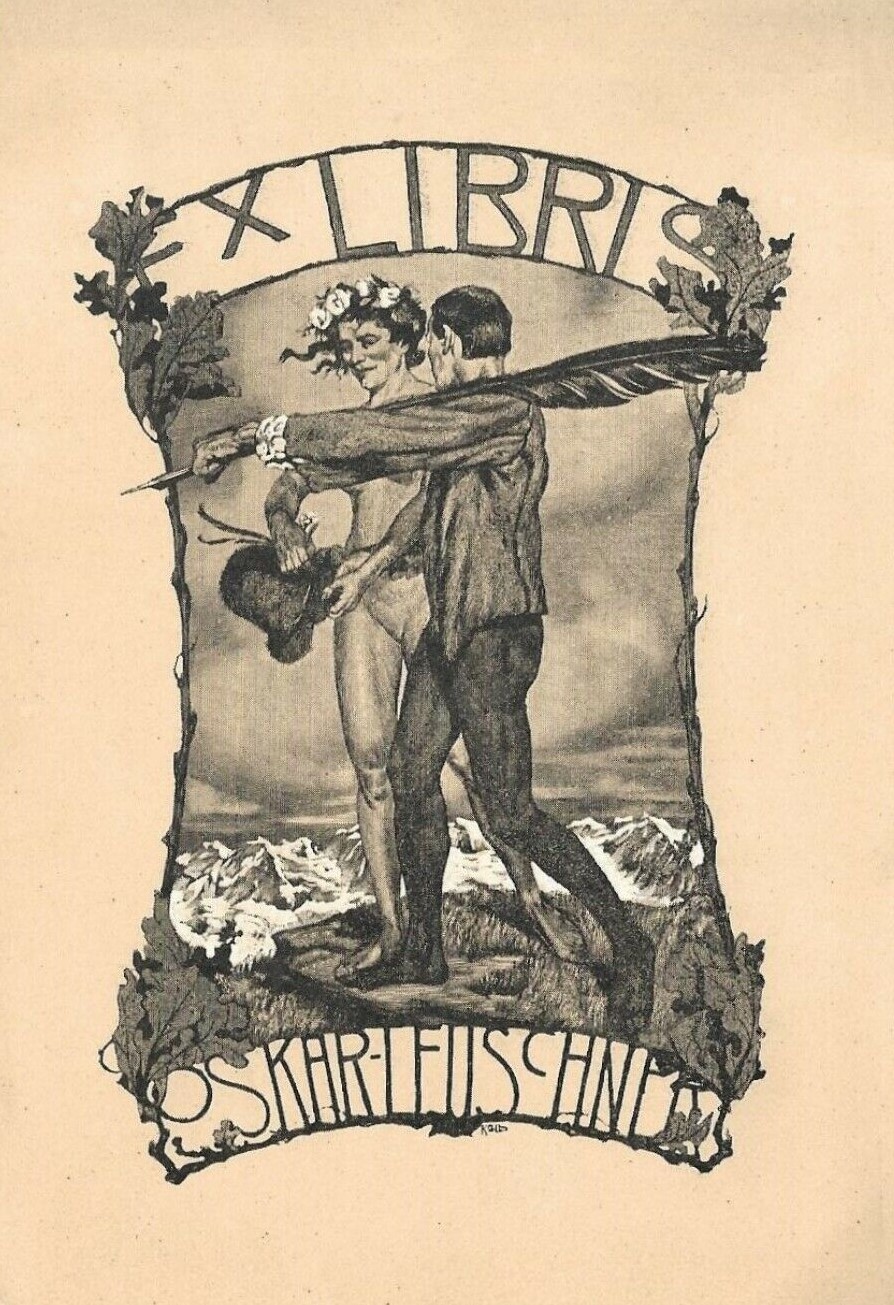
Alois Kolb y el exlibris
Aunque Kolb cultivó también el dibujo, la pintura —principalmente bodegones, retratos y desnudos— y la litografía, su principal aportación artística se encuentra en el grabado. Realizó numerosas series gráficas y carpetas de estampas, además de ilustraciones, exlibris, sellos y otros trabajos de gráfica aplicada.
Su obra combina temas de inspiración popular con composiciones de profundo simbolismo filosófico, tratadas con un lenguaje personal y refinado. Kolb participó activamente en la vida artística alemana y fue miembro del Deutscher Künstlerbund. Falleció en Leipzig en 1942, dejando un legado importante en la historia del grabado europeo del siglo XX.
Biography
Alois Kolb (Vienna, 1875 – Leipzig, 1942) was a German-Austrian engraver and painter whose career is closely linked to the development of artistic printmaking in Germany during the first decades of the twentieth century. Considered a master of etching, his work stands out for its technical precision and for a visual language of great expressive force.
The son of a German decorative painter and a Viennese mother, he spent part of his youth in Graz. In 1896 he entered the Academy of Fine Arts in Munich, where he studied painting with Karl Raupp and received training from artists such as Friedrich Fehr, Ludwig Schmid-Reutte and Ludwig von Löfftz. During these years he developed, in a self-taught way, his interest in printmaking, a discipline that would become the core of his artistic activity.
Between 1901 and 1905 he worked in Ebersberg and Murnau, near Munich, devoting himself to illustration and graphic design, among other things for the magazine Jugend, linked to the Jugendstil movement. During this period he began to produce prints of great technical quality, in which the influence of the engraver Ferdinand Schmutzer can be perceived.
From 1905 onwards he taught life drawing at the Magdeburg School of Art and, in 1907, he was appointed professor of engraving at the Königliche Akademie für graphische Künste und Buchgewerbe in Leipzig. There he directed the engraving class until his death and turned this section into one of the most prestigious of its time, training numerous artists.
Alois Kolb and the Bookplate
Although Kolb also cultivated drawing, painting —mainly still lifes, portraits and nudes— and lithography, his principal artistic contribution lies in engraving. He produced numerous graphic series and portfolios of prints, as well as illustrations, bookplates, stamps and other works of applied graphic art.
His work combines themes of popular inspiration with compositions of deep philosophical symbolism, treated with a personal and refined visual language. Kolb actively participated in German artistic life and was a member of the Deutscher Künstlerbund. He died in Leipzig in 1942, leaving an important legacy in the history of twentieth-century European printmaking.
Biographie
Alois Kolb (Vienne, 1875 – Leipzig, 1942) fut un graveur et peintre germano-autrichien dont la trajectoire est étroitement liée au développement de la gravure artistique en Allemagne durant les premières décennies du XXe siècle. Considéré comme un maître de l’eau-forte, son œuvre se distingue par sa précision technique et par un langage visuel d’une grande force expressive.
Fils d’un peintre décorateur allemand et d’une mère viennoise, il passa une partie de sa jeunesse à Graz. En 1896, il entra à l’Académie des Beaux-Arts de Munich, où il étudia la peinture avec Karl Raupp et reçut l’enseignement d’artistes tels que Friedrich Fehr, Ludwig Schmid-Reutte et Ludwig von Löfftz. Durant ces années, il développa de manière autodidacte son intérêt pour la gravure, discipline qui allait devenir le centre de son activité artistique.
Entre 1901 et 1905, il travailla à Ebersberg et à Murnau, près de Munich, se consacrant à l’illustration et au graphisme, notamment pour la revue Jugend, liée au mouvement Jugendstil. Au cours de cette période, il commença à produire des gravures d’une grande qualité technique, dans lesquelles on perçoit l’influence du graveur Ferdinand Schmutzer.
À partir de 1905, il enseigna le dessin d’après nature à l’École d’Art de Magdebourg et, en 1907, il fut nommé professeur de gravure à la Königliche Akademie für graphische Künste und Buchgewerbe de Leipzig. Il y dirigea la classe de gravure jusqu’à sa mort et fit de cette section l’une des plus prestigieuses de son temps, formant de nombreux artistes.
Alois Kolb et l’ex-libris
Bien que Kolb ait également pratiqué le dessin, la peinture —principalement des natures mortes, des portraits et des nus— et la lithographie, sa contribution artistique la plus importante se trouve dans la gravure. Il réalisa de nombreuses séries graphiques et portfolios d’estampes, ainsi que des illustrations, des ex-libris, des timbres et d’autres travaux de graphisme appliqué.
Son œuvre combine des thèmes d’inspiration populaire avec des compositions chargées d’un profond symbolisme philosophique, traitées dans un langage personnel et raffiné. Kolb participa activement à la vie artistique allemande et fut membre du Deutscher Künstlerbund. Il mourut à Leipzig en 1942, laissant un héritage important dans l’histoire de la gravure européenne du XXe siècle.